
The Intersection of the October 2025 Decoupling Event and Hayek’s Predictions
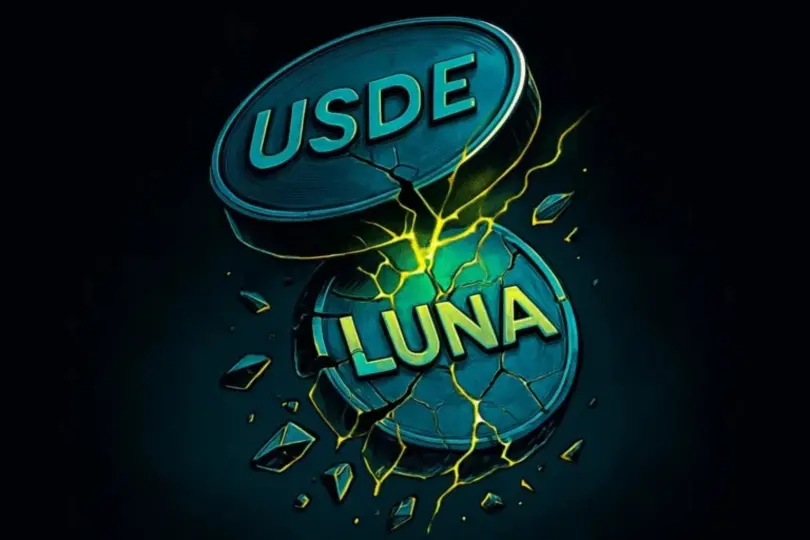
On October 11, 2025, a surge of panic within the cryptocurrency market led to a dramatic downturn, significantly impacting the synthetic stablecoin USDe. During this tumultuous period, Bitcoin’s value dropped from $117,000 to $105,900—an alarming 13.2% decline in just one day—while Ethereum saw a decrease of 16%. USDe itself fell to approximately $0.65, a steep drop of around 34% from its intended $1 peg, before making a swift recovery within hours. This incident also witnessed an unprecedented liquidation event, with global crypto liquidations reaching $19.358 billion in a single day, forcing 1.66 million traders to close their positions—an all-time record. On a micro level, the liquidity pool for USDe-USDT on the decentralized exchange Uniswap plummeted to just $3.2 million, an 89% reduction from pre-crash levels, resulting in a 25% discount for a sell order of 100,000 USDe due to slippage. Additionally, six prominent market makers faced risks of liquidation with a 40% drop in margin value as they utilized USDe for cross-margin trading, further intensifying the liquidity crisis. Nevertheless, within 24 hours, USDe’s price rebounded to $0.98, bolstered by third-party reserve proofs from Ethena Labs showing a collateralization ratio above 120% and a significant over-collateralization of $66 million. Importantly, the user redemption function remained operational, allowing for the redemption of assets like ETH and BTC at any time, which played a crucial role in restoring market confidence. The MaiTong MSX Research Institute noted that this “drop-recovery” trend starkly contrasts with the total collapse that followed the LUNA-UST decoupling in 2022, positioning this event as a pivotal stress test of Hayek’s theory on “The Denationalization of Money” in today’s digital landscape.
Mechanism Innovation of USDe
The USDe stablecoin employs a “collateral-hedging-yield” framework that reflects the logic of spontaneous market adjustments rather than relying on centralized planning. This design aligns with Hayek’s notion that market order emerges from individual actions. The collateral system backing USDe adheres to the liquidity consensus within the cryptocurrency market, with ETH and BTC together constituting over 60% of its collateral. These assets have gained recognition as “hard assets of the digital realm” through over a decade of trading, without any institutional designation. Additionally, liquid staking derivatives such as WBETH and BNSOL have organically emerged from the market to improve capital efficiency, allowing for staking returns while maintaining liquidity. A 10% allocation to stablecoins like USDT and USDC acts as a “transitional stable tool,” providing a safety net for USDe during turbulent market periods. Throughout the October 2025 incident, the collateral system remained over-collateralized, with a ratio exceeding 120%, and managed through smart contracts for real-time valuation and automatic liquidation.
Stability Mechanism: Spontaneous Hedging in the Derivatives Market
USDe distinguishes itself from conventional fiat-backed stablecoins due to its detachment from national currency reserves, opting instead for risk management through short positions in the derivatives market. This innovative approach leverages the liquidity offered by the global crypto derivatives market, enabling the market to absorb price fluctuations. For instance, when ETH’s price surges, profits from spot assets offset losses from short positions; conversely, if ETH’s price declines, profits from shorts counterbalance spot market losses—all without centralized intervention, driven solely by market price signals. Even during the 16% drop in ETH in October 2025, the hedging mechanism experienced only a temporary lag due to a liquidity drain, but ultimately proved effective, with Ethena Labs’ short positions generating $120 million in unrealized gains through voluntary trading within the derivatives market.
Yield Mechanism: Spontaneous Incentives to Attract Market Participation
USDe’s model combines “staking yield” and “circular lending,” which diverges from the traditional finance approach of rigid high-interest repayments. Instead, it offers reasonable compensation to participants willing to take on risk. The foundational 12% annualized subsidy is derived from the organic investment of ecosystem funds aimed at enhancing money circulation. The mechanism allows users to amplify leverage between 3 to 6 times, yielding annual returns of 40-50% through circular lending. This flexibility enables users to autonomously select their risk-return profile; those willing to accept higher leverage can pursue greater returns, while those with a more conservative risk appetite can engage in basic staking.
Comparison of Three Types of Stablecoin Mechanisms: The Divide Between Market Choice and Administrative Intervention
The October 2025 decoupling event is frequently misinterpreted as indicating a similar risk profile between USDe and LUNA-UST. However, from an Austrian School perspective, the crucial distinctions were illuminated during this market test. The recovery of USDe exemplified the success of a “non-nationalized currency undergoing market validation,” contrasting sharply with the collapse of LUNA-UST, which stemmed from a flawed “pseudo-innovation” divorced from real asset backing.
The Essential Difference in Value Anchors: Real Assets vs. Void Expectations
USDe’s value is anchored in tangible assets like ETH and BTC that users can redeem at any moment. Even during extreme market conditions, the redeemable nature of these assets ensures users can acquire equivalent cryptocurrencies. During the October 2025 decoupling, USDe’s redemption mechanism remained intact, supported by third-party reserve confirmations demonstrating over-collateralization of $66 million. This redeemable value commitment is foundational to market trust. Conversely, LUNA-UST lacked any real asset backing, relying solely on speculative user expectations regarding LUNA’s price. When market turmoil erupted, the UST redemption process necessitated more LUNA issuance, leading to an unsustainable cycle that culminated in systemic collapse. This “currency without asset backing” fundamentally violated Hayek’s principle that valid money must have a real value foundation, rendering its downfall inevitable.
The Logical Difference in Crisis Response: Market Spontaneous Repair vs. Administrative Intervention Failure
In the aftermath of the decoupling, USDe’s response adhered strictly to market logic. Ethena Labs refrained from imposing a top-down rescue plan; instead, they communicated transparency and assurance regarding assets through public reserve disclosures, optimized collateral structures, and limited leverage, relying on market participants’ organic trust to facilitate price recovery. In stark contrast, LUNA-UST’s crisis management exemplified “administrative intervention failure.” The Luna Foundation Guard’s attempts to stabilize the market by liquidating Bitcoin reserves were inadequate, as centralized actions could not withstand the market’s natural sell-off—especially when Bitcoin itself faced declines during the crisis.
The Difference in Long-Term Viability: Market Adaptability vs. Mechanism Fragility
Following the decoupling, USDe not only regained its price but also enhanced its long-term adaptability through structural optimizations. These included capping circular lending leverage at two times, incorporating compliant government bond assets (USDtb) to bolster collateral stability, and diversifying hedging strategies across exchanges. These adjustments were not the result of top-down directives but were responsive to market feedback, thereby aligning closely with the principle of “matching risk and return.” In contrast, LUNA-UST’s framework lacked adaptability from the outset, with its Anchor protocol’s unsustainable 20% interest dependent on continuous subsidies from ecosystem funds, which were not backed by genuine demand. When these subsidies faltered, the entire system collapsed rapidly.
Mechanism Flaws and Critical Reflection: The Growing Pains of Non-Nationalized Currency
While the innovative nature of USDe is clear, the stress test in October 2025 and ongoing operations reveal flaws that diverge from Hayek’s vision of complete market self-regulation. These risks are not insurmountable defects but hurdles that must be navigated for its evolution into a mature non-nationalized currency.
Concentration Risk in Collateral: Systemic Binding to Crypto Asset Cycles
More than 60% of USDe’s collateral is tied to ETH and BTC, aligning with the liquidity consensus of the crypto market but also exposing it to the risk of over-reliance on a single market cycle. The October 2025 decoupling was essentially a chain reaction triggered by a sharp decline in the crypto market; despite hedging through derivatives, the rapid loss in collateral market value incited widespread panic. Compounding the issue, the auxiliary collateral in the form of liquid staking derivatives remains tethered to the Ethereum ecosystem, rendering it a “secondary derivative of crypto assets” and failing to achieve genuine risk diversification. This “internal circulation of crypto assets” within the collateral framework appears precarious compared to traditional currencies that are underpinned by real economic value.
Limitations of the Hedging Mechanism: Implicit Dependence on Centralized Exchanges
USDe’s hedging strategy is heavily reliant on the liquidity available from leading centralized exchanges. The temporary lag in the hedging mechanism during October 2025 was the result of a liquidity shortfall caused by one of the leading exchanges halting perpetual contract trading. Currently, approximately 70% of USDe’s short positions are concentrated on just two exchanges, making it susceptible to the operational rules of these centralized platforms. Additionally, the volatility of funding rates exposes the limitations of the hedging tools available. At present, USDe depends exclusively on perpetual contracts for risk hedging, lacking a diversified array of instruments, such as options and futures, which hinders its capacity to adapt hedging strategies during periods of extreme market imbalance.
RWA Anchoring Upgrade: The Advancement Path of Non-Nationalized Currency
Addressing the existing challenges, integrating Real World Assets (RWA) such as gold tokens and US stock tokens is not only a necessary correction for USDe’s shortcomings but also aligns with the burgeoning RWA market, projected to reach $26.4 billion in 2025, reflecting a year-on-year growth of 113%. This upgrade supports the principles of non-nationalization while invigorating Hayek’s ideas in the modern context by connecting with real economic value.
The Underlying Logic of RWA Anchoring
The foundation of money should derive from real assets that command widespread market consensus, a characteristic inherent to RWA assets. Gold, recognized as a stable currency for millennia, possesses a value consensus that transcends borders and eras. US stock tokens reflect the actual returns generated by publicly traded companies, anchoring the value creation capability of enterprises. Similarly, government bond tokens are tied to the tax capacity of sovereign nations, offering a low-volatility value benchmark. The worth of these assets is independent of the cryptocurrency market cycle, allowing for the establishment of a “cross-market value buffer” for USDe. The BUIDL token, launched by BlackRock in 2024 and anchored to US government bonds, has demonstrated the viability of RWA anchoring. Unlike USDe, BUIDL relies on centralized institutions for issuance, while USDe can achieve decentralized confirmation and valuation of RWA assets through smart contracts, truly embodying the principle of “market spontaneous management.”
Adaptation and Configuration Strategies for Diverse RWA Assets
The RWA anchoring enhancement of USDe should adhere to the principles of “market consensus first, risk diversification adaptation.” With the maturation of RWA tokenization, a “core-auxiliary-flexible” three-tier configuration system can be established. This approach could reduce the proportion of crypto asset collateral in USDe from the current 80% to a range of 40% to 50%, preserving the liquidity advantages inherent to the crypto market while achieving cross-market risk diversification via RWA assets. For instance, gold tokens, which exhibit a low correlation with ETH prices, can function as a “value anchor” during declines in the cryptocurrency market, mitigating panic-driven sell-offs similar to those witnessed in October 2025.
Reinsights from the Austrian School: The Evolutionary Logic from Innovation to Maturity
The identified flaws in USDe and the proposed RWA upgrade path underscore the enduring relevance of Hayek’s “The Denationalization of Money”: non-nationalized currency represents a dynamic process of market evolution rather than a static mechanism. Only through ongoing self-correction and innovation can it achieve success in monetary competition.
The Evolution of Value Foundations: From Single Market Consensus to Cross-Domain Value Anchoring
Currently, USDe’s collateral, predominantly composed of crypto assets, reflects the “primary form” of non-nationalized currency in the digital age, with its value consensus limited to cryptocurrency market participants. By incorporating RWA assets, the objective is to broaden the value consensus to encompass traditional finance and the real economy, thereby advancing USDe’s value foundation from “digital consensus” to “cross-domain real value.” This transition aligns with Hayek’s assertion that “the value of money should derive from the broadest market trust.” When USDe anchors a diverse array of assets—including cryptocurrencies, gold, and US equities—it significantly enhances its ability to withstand risks associated with any single market, evolving into a “value carrier that transcends sovereignty and individual markets.”
The Improvement of Adjustment Mechanisms: From Single Tools to Diverse Market Synergy
Currently, USDe’s hedging framework relies solely on one derivatives market, revealing an “insufficient utilization of market tools.” Hayek emphasized that “market self-repair” should leverage diverse market synergies. The integration of RWA assets not only enriches the collateral base but also opens the door to synergistic hedging strategies that combine the “crypto derivatives market + traditional financial market.” For instance, the volatility of US stock tokens can be mitigated through traditional stock options, while gold tokens can be secured with forward contracts in the London gold market, enhancing the resilience of the hedging mechanism and reducing dependency on the liquidity of a single market.
Conclusion: The Leap from Innovation Benchmark to Evolutionary Model
The market test of October 2025 not only affirmed USDe’s value as a benchmark for non-nationalized currency innovation but also illuminated its trajectory from “initial innovation” to “mature currency.” Its essential distinction from LUNA-UST lies in the backing of real value and market adaptability; the current operational flaws represent the growing pains inherent in the innovation process. The MaiTong MSX Research Institute posits that incorporating RWA assets like gold tokens and US stock tokens offers a clear path for USDe’s evolution. This strategy does not negate existing innovations but rather enhances and refines them in accordance with Hayek’s principles. For market participants, USDe’s evolutionary journey provides critical insights: the core strength of non-nationalized currency lies in its willingness to challenge sovereign monopolies and its capacity for continuous self-correction. The criteria for evaluating its worth should encompass not only immediate stability but also its long-term resilience in connecting with real value and adapting to market shifts. Once USDe completes the RWA upgrade, it will transcend being merely an experimental innovation within the crypto market, emerging as a genuine “cross-domain value carrier” poised to challenge traditional monetary frameworks. ChainCatcher advises readers to approach blockchain with a rational mindset, heightening risk awareness and exercising caution regarding various virtual token offerings and speculative activities. The content presented on this platform is solely for informational purposes and does not constitute financial advice. If any sensitive information is identified, please report it for prompt action.


